Kingdom's Gallery Tours
Journey Beyond the ordinary
Day by Day
Land at Paro international airport and drive towards Thimphu. (55km.1 hour & 20 minutes’ drive
from the airport.
Upon your arrival at Paro International Airport, complete the immigration procedures and retrieve your luggage. Our representative, a professional certified tour guide and a driver, will
greet you with the white scarf ( khadhar ) symbolizing the Bhutanese tradition of welcoming the
guest. Perhaps you can ask the guide why only the white scarf is used to welcome any guest.
They will then drive you to Thimphu, the capital city of Bhutan. On the way, they will stop at
Tachog to take a picture if you are interested. Upon your stop at Tachog on the way to Thimphu,
you will witness the iron chain bridge made by Tibetan saint Thang Thong Gaylpo, also
commonly referred to as the iron chain master. Believed that he had made more than 100 iron
bridges across Bhutan him but now few are left intact as bridge positions. Some people even take
a self-blessing from the iron chain bridge by placing their head on the iron chains. Just above the
bridge, one can also witness his temple and meditation café around it. Upon arrival, check into
the accommodation in Thimphu and later visit Tashichodzong and explore Thimphu city with
over 100000 population, perhaps the most densely populated town in Bhutan.
National Memorial Chorten
You will start with a visit to the holiest stupas. Built in 1974 by the grand queen mother, asji
phuentsho choden wangchuck in memory of his son third king Jigme Dorji Wangchuck, who
passed away in 1972, it is believed that the late third king had a wish to build a stupa at that very
juncture, and often refer to him as the father of modern Bhutan for his work in connecting
Bhutan with motorable road with India and bringing other major reforms in education and health
sectors. The relic inside consists of the Vajakiliya teaching and family sacred in the Vajrayana
teaching, and they were consecrated by the great Buddhist master Dujom Jigdrel Yeshay Dorji.
And designed by Dungsay Thinly Norbu.
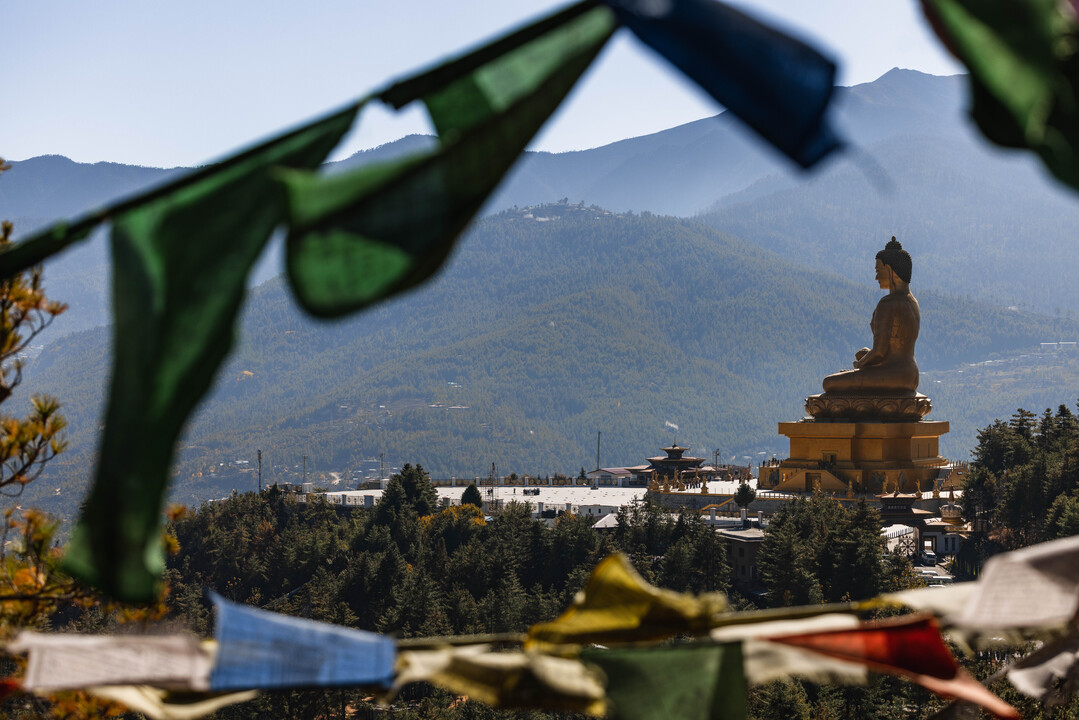
Buddha Dordenma
Built according to the prophecy of Lama Sonam Zangpo, facing the south of Thimphu to bring
peace and stability in the region. late lama Sonam Zangpo was a direct disciple of Drubwang
Shakya Shri, who specialized in the six yogas of Naropa. Built in 2006, today it is the highlight
of every tourist with a 51-meter-tall bronze statue of Buddha standing tall overlooking the south
of Thimphu. One can also enjoy the breathtaking view of the south of Thimphu and climb down
over 200-plus steps while exiting.
Royal Takin park
If one wishes to see the national animal of Bhutan in live then one must visit the Royal Takin
Park. According to the Bhutanese myth and folklore, it is believed to have been miraculously
created by lama Drukpa Kuenley, or the divine madman, during the 14th century by affixing the
carcass of head of goat to the body of a cow, giving it its unique appearance. The park was
established in 1974 to serve as a sanctuary; now it has become a rehabilitation hub for injured
wild animals, especially for herbivores. Today, the injured wild animal is brought in and given a
safe sanctuary until they recovers and are released back into the wild. You can find different
species of herbivores, like takin, sambar deer, mountain goral, barking deer, blue sheep even
birds like tragopan and Himalayan monal were once heavily hunted for their beautiful, patterned
feathers. Now the number of these endangered bird species is slowly rising with the help of
social awareness programs from the government, and ironically, the abundant presence of plastic
tapes.
Royal Textile Academy
Under the patronage of queen mother ashi sangay conden wangchuck it was initiated in the year
2015 to preserve the culture of traditional weaving and using rare earth minerals and plants base
pigments as dire. one can see different patents of dress being displayed for both men and women
but after visit you can pretty much conclude that women have a lot variety of colors and patents
to choose compare to men. You can also see different dresses being worn by people in certain
villages, other than the gho and kira.
Simply Bhutan – living museum
This one particularly shows the inside of Bhutan in a very traditional way. After reaching there, a
female in-house guide will take over the guest and let you all experience how a guest was
welcomed in Bhutan in olden days with the offering of locally brewed alcohol called ara. After
that, one can witness how traditionally houses are built using damp soil and repeatedly ramping
it, and with it a song being sung, cheering and urging the other person the fetch the damp soil
quickly. You will also experience your hand in archery, the national sport of Bhutan.
Overnight stay in hotel or resort in Thimphu
On towards Punakha District in the morning and stop at Dochula Pass, the weather up the would
be quite cold compared to Thimphu, cause by then you would have ascended to 3100 meters
above sea level or 10171 feet. If the weather is clear, one can witness the wide range of the
Himalayas towards the northern side. Beyond this, the central attraction of this place is the 108
stupas built to honor the fallen Bhutanese soldiers and Druk Wangyal Lhakhang built to honor
the bravery of the 4th Druk Gyalpo for leading the army himself in the war in 2003 to flush out
the Indian insurgents who were occupying the Bhutanese territory.
Chimmi Lhakhang
This temple is well known for giving blessings to infertile women to conceive and bless the
newborn children, so you will witness newborn children brought up there and women carrying a
phallus and circling the temple in a clockwise direction. The place is renowned for Bhutanese as
well a foreigners who believe and have been blessed with children and protection from the local
deity.
The reason the temple is called as temple of fertility is related to the Tibetan Buddhist master
Drukpa Kuenlay, who is often called by Westerners as Divine Madman. Drukpa Kuenlay was
known for his eccentric and unconventional way of teaching Buddhism. He did not believe in
institutional establishment to spread Buddhism; rather, he used an unorthodox way of teaching
and enlightening individuals. Canting, sexually abusive verbal, and showing his phallus to
subdue demons and evil spirits were some of his methods. best best-known example of
enlightening an individual is Wola Gap and the old man from Wolakha, who was a hardcore
believer of his teachings. It is believed that the old man started chanting sexually abusive prayers
instructed by Drukpa Kunley, so much so that he even chanted during the presence of his family
members. Whereby he was forced to leave the village and stay in isolation, it is said that during
his enlightenment, he called upon his family and village to witness his enlightenment.
Today, one can witness the stupa inside Chimi Lhakhang, where his clots and remaining items
are kept inside the stupa after his physical body attained enlightenment.
That is why you see paintings of phalluses on Bhutanese houses to get rid of evil spirits and
gossip. In shops, one can get phalluses carved from wood, stone, and synthetic materials.
There are likely chances that tourists can misinterpret the painting and objective phallus as a
representation of male genital. These painting and carvings only represents the phallus of Drukpa
Kunley, so do not be ashamed while visiting and receiving blessings at Chimi Lhakhangs.
Punakha Dzong
The Punakha Dzong, also known as Pungthang Dewa Chhenbi Phodrang (the palace of great
happiness). Constructed in the year 1637 by Zhabdrung Ngawang Namgyal to fulfill Guru
Padmasambhava's prophecy. It is the second fortress built by him after Semtokha Dzong. It is
known for its majestic architectural designs and sacred relics. The dzong houses the sacred relics,
including the Rangjung Kharsapani and the sacred remains of zhabdrung Ngawang
Namgyal. The dzong is located between the Pho chhu (male) and Mo chhu (female)
rivers. Today, it serves as the winter residence of the monastic body, where they spend 6 months
in Punakha Dzong and migrate to Thimphu during summer. These practices of migration during
summer and winter are to preserve the tradition initiated by dzabdrung Ngawang Namgyal, and
thousands of people line up to receive the blessing of the sacred relic, which is only brought out
during this migration. Punakha district was the capital of Bhutan until 1955, when the capital
was shifted to Thimphu. Historically important events of Punakha Dzong can be traced back as
early as 1900, when the first documented British missionary explorer, John Claude, visited
Bhutan through Punakha Dzong in 1905 and had a rough encounter with Bhutanese delegations,
thus leading to the duar war with the British army.
- In 1907, Sir Ugyen Wangchuck was crowned the first king of Bhutan in Punakha Dzong.
- On 8th January 1910, the treaty of Punakha was signed by Indian British with Bhutan in the
Punakha fortress.
- 1953 first national assembly was held in Punakha Dzong.
Today, the Punakha Dzong stands tall and majestic, surrounded by jacaranda trees where they
bloom purple flowers between May to June, and looks even more amazing.
Sangchhen Dorji Lhuendrup Nunnery
A nunnery is a monastic establishment where only women dedicate their lives to practicing
dharma. It was built by Yab Ugyen Dorji and Yum Thuji Zam (they are parents of the queen
mothers of Bhutan) in 2008 and completed in 2010. It’s believed that the purpose of establishing
this nunnery was according to the prophecy made by the 69th abbot Khenpo Je Gadhen Rinchen.
Today, this establishment serves as a college and supports around 120 nuns.
Suspension bridge.
Considered as one of the longest suspension bridges in Bhutan spanning around 260 meter long,
one can come here and relax, enjoying the view of the lush valley and Pho Chhu (male) river.
Overnight stay in hotel or resort in Punakha
we will return to Paro district in the early morning, which is around 3 3-hour drive from Punakha
district. Upon our arrival, we will explore these itineraries.
Paro Ringpung Dzong
If one sees this fortress from a distance and observes, it's believed that one can see the fortress
looks like it is being built upon a heap of jewels. That is why it is called a ringpung, which
means heap of jewels and was built in the year 1646 by the first paro penlop under the command
of zhabdrung nagwang Namgyal. The sacred relics that are housed in this fortress are a single
cymbal, which is believed to have been discovered by the treasure reveler Sherab Mebar, and
thongdrel, which means liberation by sight, is a gigantic silk appliqué tapestry of Guru
Padmasambhava. which is brought out during paro festival in the 15th day of the second
Bhutanese lunar month and displayed to public at early hours around 3am in the morning.
we will return to Paro district in the early morning, which is around 3 3-hour drive from Punakha
district. Upon our arrival, we will explore these itineraries.
Paro Ringpung Dzong
If one sees this fortress from a distance and observes, it's believed that one can see the fortress
looks like it is being built upon a heap of jewels. That is why it is called a ringpung, which
means heap of jewels and was built in the year 1646 by the first paro penlop under the command
of zhabdrung nagwang Namgyal. The sacred relics that are housed in this fortress are a single
cymbal, which is believed to have been discovered by the treasure reveler Sherab Mebar, and
thongdrel, which means liberation by sight, is a gigantic silk appliqué tapestry of Guru
Padmasambhava. which is brought out during paro festival in the 15th day of the second
Bhutanese lunar month and displayed to public at early hours around 3am in the morning.
Ta Dzong - National Museum of Bhutan
Built in 1649 by la ngongpa tenzin drukdra, overlooking Paro valley, the ta dzong serves as a
watch tower to alert the Paro valley during enemy invasions. In 1965, under the command of the
third king Jigme Dorji Wangchuck, the ta dzong (watch tower) was converted into to national
museum. A major renovation was done, and in 1968, ta-dzong was opened to the public. Today,
it houses different old artifacts, from paintings to sculptures and weaponry.
Overnight stay in hotel or resort in ParoTa Dzong - National Museum of Bhutan
Built in 1649 by la ngongpa tenzin drukdra, overlooking Paro valley, the ta dzong serves as a
watch tower to alert the Paro valley during enemy invasions. In 1965, under the command of the
third king Jigme Dorji Wangchuck, the ta dzong (watch tower) was converted into to national
museum. A major renovation was done, and in 1968, ta-dzong was opened to the public. Today,
it houses different old artifacts, from paintings to sculptures and weaponry.
Overnight stay in hotel or resort in Paro
It is believed that during Guru Padmasambhava's second visit to Bhutan during the 8th century,
he visited Taktshang and subdued the evil deity and meditated there for a long time. It is said that
during the subjugation of the deity, he discovered one of his wrathful manifestations, called Guru
Dorji Dorlo, riding on the tigress. After the guru Padmasambhava's visit to Taktshang, the
sacredness of the place became renowned, and many Buddhist masters followed to visit and
meditate there, eventually blessing the place. On the dates 24,25, and 26 of the fifth Bhutanese
lunar month, a vajra discovered by Guru Padmasambhava at Taktshang is displayed to the public
once every year.
Overnight stay in hotel or resort in Paro
Thank you for visiting Kingdom of Bhutan
and trusting your travel partner kingdom’s Gallery Tour